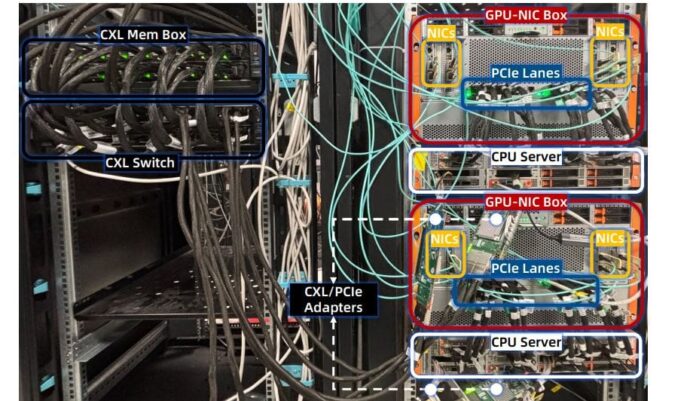
The rising demands of large language models (LLMs) strain memory systems, particularly the KVCache. Researchers Xinjun Yang, Qingda Hu, and Junru Li have introduced Beluga, a novel memory architecture utilizing the Compute Express Link (CXL) standard. This innovation allows GPUs and CPUs to share a unified memory pool, addressing capacity limitations and improving performance over traditional configurations. Beluga dramatically reduces latency, achieving an 89.6% reduction in Time-To-First-Token (TTFT) and a 7.35x throughput increase compared to remote direct memory access (RDMA) solutions. By enabling near-local memory access speeds, this system simplifies programming and enhances efficiency for LLM inference. The research explores potential optimizations like scalable storage engines, caching strategies, and data locality techniques, aiming to accelerate AI workloads and improve memory expansion for in-memory databases. Overall, Beluga stands out as a key advancement in memory architecture, offering efficient access and performance improvements crucial for LLM tasks.
Source link
Unlocking Performance: CXL Architecture Delivers 7.35x Speed Increase and 89.6% Efficiency in LLM KVCache Management
Share

Read more