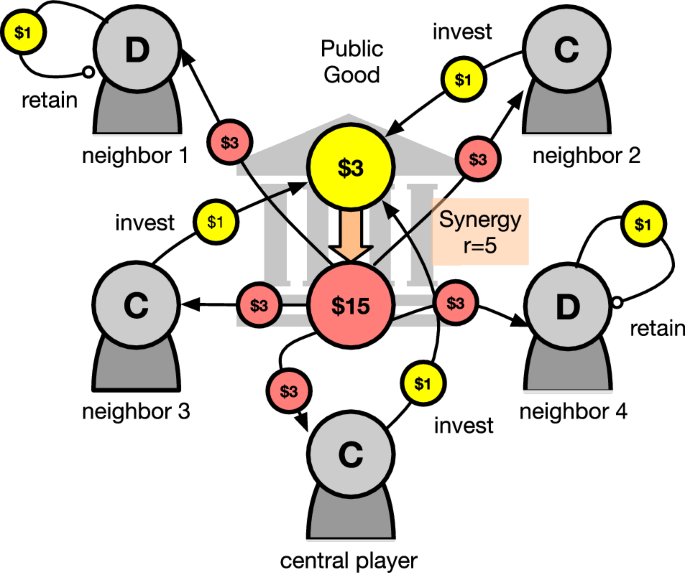
This study investigated the role of AI agents in promoting cooperation within Public Goods games across three policy scenarios: Mandatory Cooperation, Player-Controlled Cooperation, and Agent Mimicry. Results revealed that merely enforcing cooperation or allowing players to control AI behavior did not enhance human cooperation. However, when AI agents mimicked human cooperative actions, the critical synergy threshold for cooperation significantly decreased, fostering a cooperative environment. This innovative approach highlights the power of reciprocity and adaptive responses in enhancing collaboration. Notably, while the model simplifies complex real-world interactions, it serves as a foundation for future research, incorporating learning mechanisms and network structures to reflect nuanced human-agent dynamics. Ethical considerations regarding AI’s influence on behavior remain crucial, ensuring that cooperative promotion does not infringe on autonomy. Overall, these findings advocate for developing AI systems that dynamically respond to human behavior, potentially transforming social interactions and fostering cooperation in complex societies.
Source link
Share

Read more