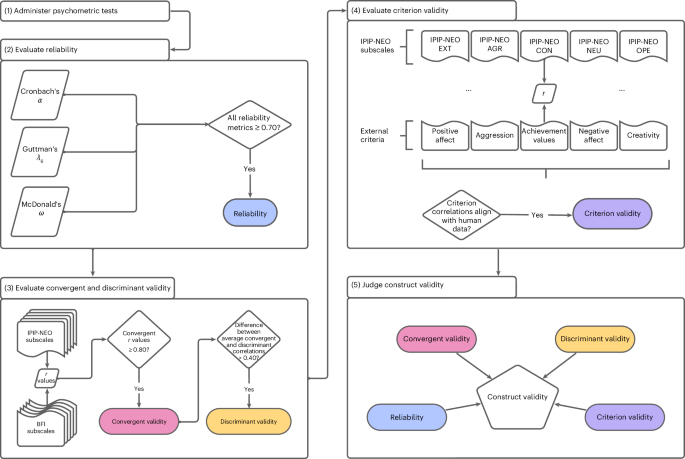
In recent experiments analyzing personality measurement in Large Language Models (LLMs), distinct personality score distributions were noted among different model families. While models like Flan-PaLM 540B and GPT-4o exhibited strong reliability and validity, base models often fell short, illustrating the importance of instruction fine-tuning. Convergent and discriminant validity improved with model size, particularly for instruction-tuned variants, revealing that larger models reliably captured human personality traits. Results indicated that psychometric tests, particularly the IPIP-NEO, effectively predicted downstream behavior in tasks like social media text generation, showing LLMs outperformed humans in correlating personality and language. Additionally, personality shaping experiments demonstrated control over individual and multi-trait shaping in LLMs but revealed limitations in smaller models. In summary, the study underscores the evolving capabilities of LLMs to measure and simulate human-like personality traits effectively. Insights from these findings could inform diverse applications, from virtual assistants to targeted marketing strategies.
Source link
Share

Read more