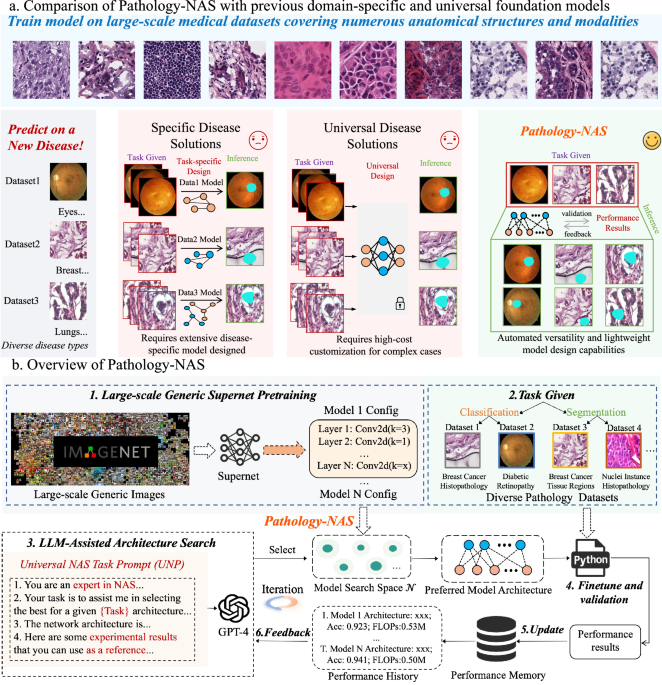
In this study, we present a robust framework for pathology image analysis utilizing large-scale datasets from various sources like Kaggle and Grand-Challenge. We employed datasets such as BreakHis, Diabetic Retinopathy, SkinTumor, and Gastric Cancer for classification tasks, and BCSS and PanNuke for segmentation, ensuring diverse coverage of histopathological images. A novel LLM-driven Neural Architecture Search (NAS) was developed to optimize model architectures, leveraging GPT-4 for efficient design exploration. By integrating CNNs and Vision Transformers within a supernet framework, our approach maximizes performance while adhering to computational constraints. Training involved rigorous protocols and evaluation metrics, including accuracy and Dice Coefficient for segmentation. This methodology ensures high accuracy in medical image classification and segmentation, paving the way for enhanced diagnostic tools in the field. Our ethical practices adhered to regulations, utilizing only publicly available datasets while maintaining confidentiality and compliance. This innovation underscores the potential of AI in medical diagnostics.
Source link
Optimizing Neural Architecture with Large Language Models for Efficient Universal Disease Diagnosis in Histopathology Slides
Share

Read more