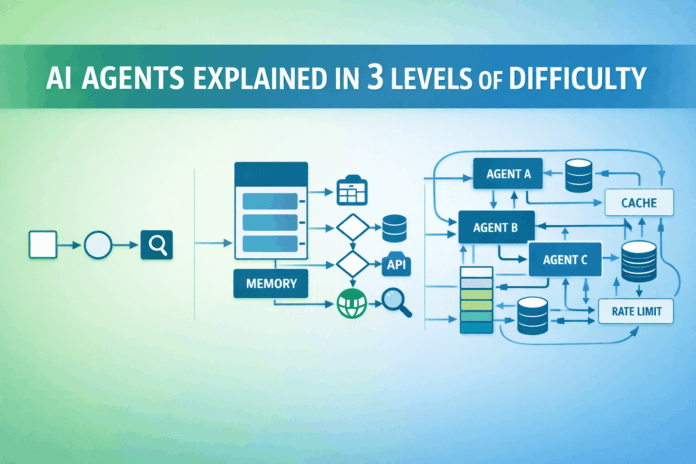
Artificial intelligence (AI) agents mark a significant evolution in autonomous systems, enabling them to plan, execute, and adapt effectively. Unlike traditional chatbots that provide single answers, AI agents process complex goals, utilizing tools for data retrieval and execution. Key functionalities include tool use, enabling interaction with external APIs, and planning, which breaks down tasks into actionable steps. Memory capabilities help agents retain context throughout interactions, preventing aimless loops.
To build effective AI agents, developers should focus on explicit architectural patterns like ReAct (Reason + Act) and Plan-and-Execute for better decision transparency. Rigorous evaluation metrics—including task success rate and action efficiency—help refine agent performance in real-world applications. Moreover, ensuring safety through guardrails and auditing, along with comprehensive observability for debugging, is crucial. Ultimately, AI agents transform the landscape of language models, requiring a robust approach to design, deployment, and optimization.
